
How to Prep Grab-and-Go Breakfasts for the Week
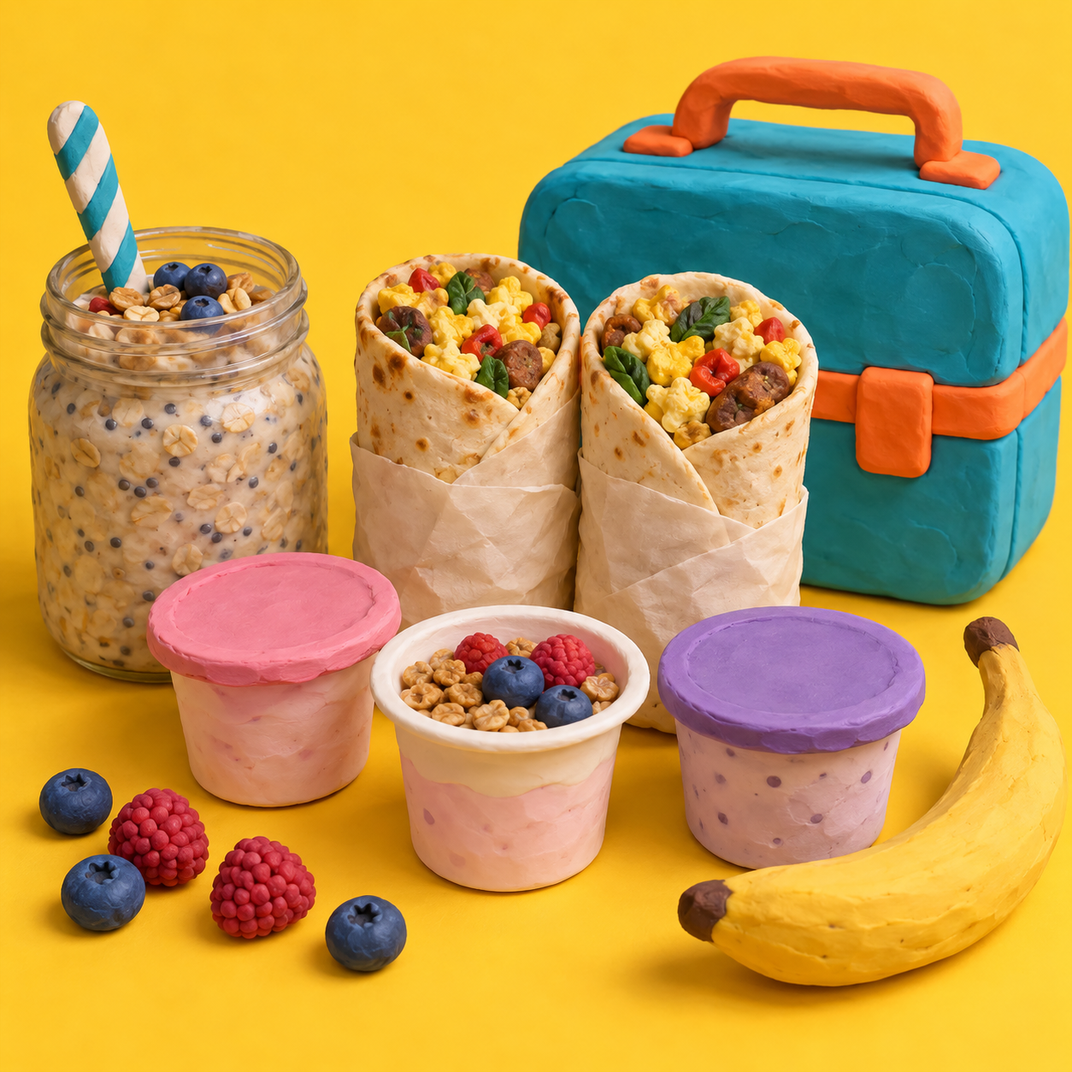
Choose three breakfasts your family already likes and plan a weekend prep session around them. You need jars or containers, a shopping list and time to cook, portion and store the food.
Having breakfast made and portioned gives your family fewer things to prepare in the morning. Start with one recipe if a full session does not fit your weekend.
Step 1: Pick three breakfasts, not seven
Some prep plans ask for more variety than a school week has time for. Choose three grab-and-go breakfasts your family already likes and rotate them across the week. Good candidates share three traits: they hold well in the fridge, they portion into single servings, and they travel from fridge to hand with zero assembly.
Reliable starters:
- Egg muffins baked in a muffin tin
- Overnight oats in jars
- Yogurt parfait cups with granola on the side
- Breakfast burritos wrapped and chilled
- Peanut butter banana oat bars
Step 2: Shop your kitchen first
Before you write a list, open the fridge, freezer and pantry. Oats, eggs, frozen berries, tortillas, peanut butter and yogurt are the backbone of most grab-and-go breakfasts, and you may already own half the week. What you find decides what you buy, and that is money back in your pocket. If your storage zones are already labeled, this check takes two minutes; our guide to labeling your pantry, fridge and freezer makes it nearly instant.
Step 3: Make one shopping list
Write exactly what the three recipes need for five days, in the amounts you need. One list, one trip. When every item on the list has a job, nothing wilts in the crisper drawer by Thursday.
Step 4: Set aside one prep session
Pick a weekend window when the kitchen is free, put on something good to listen to, and give the session a clear finish line: everything cooked, portioned and stored. Allow about an hour for this sample session, plus any cooling time. Your recipes, batch sizes and kitchen setup may need longer.
Step 5: Prep in the right order
Work from longest-cooking to no-cook, and the session flows by itself:
- Oven first. Get the egg muffins or oat bars baking. The oven timer is your session clock.
- Stovetop next. Scramble burrito filling or cook any warm components while the oven runs.
- No-cook last. Assemble overnight oats and parfait cups while hot things cool.
- Portion and label. Single servings into jars, wraps or containers, oldest toward the front.
Step 6: Store smart
Keep the week's food safe and tasty with a few simple rules:
- Cooked egg dishes keep three to four days in the fridge, per the FoodSafety.gov cold storage chart. Serve those in the first half of the week, or freeze half and thaw midweek.
- The BBC overnight oats recipe keeps three days in an airtight container in the fridge, so date the lids and front-load them. Once oats, milk and yogurt are mixed, the jar runs on its own clock as a prepared food, not the dates on the cartons.
- Burritos freeze well. Wrap each one, freeze on a tray, then bag them together. Reheat until steaming hot all the way through; 165°F is the safe temperature for leftovers.
- Keep granola and crunchy toppings separate until serving so they stay crisp.
- Freeze the portions meant for Thursday and Friday on prep day, so nothing waits past its window.
Step 7: Put breakfast where hands go
Clear one fridge shelf at kid height and make it the breakfast station. Jars and containers go there, labels facing out, Monday in front. Add a basket in the pantry for the shelf-stable parts like granola bars or napkins. Kids who can safely manage the fridge and containers can serve themselves, and younger kids can pick their jar while you handle the rest.
A sample prep session
Here is one full session, start to finish:
- Heat the oven to 350°F and grease a 12-cup muffin tin.
- Whisk a dozen eggs with about a cup of chopped peppers and a cup of shredded cheese, fill a greased 12-cup muffin tin, and bake at 350°F until the centers are set with no runny egg, about 20 minutes; egg dishes are done at 160°F on the safe temperature chart linked above.
- While they bake, fill five jars with oats and milk in roughly equal parts, about half a cup of each per jar, plus a handful of frozen berries for overnight oats.
- Layer yogurt and fruit into four cups, with granola in small containers on the side.
- Let the egg muffins cool until the steam stops, then pack them two per container and into the fridge; perishable food goes back in the refrigerator within two hours per FoodSafety.gov's food safety steps.
- Line the breakfast shelf: muffins and oats in front, parfaits behind, granola basket on the pantry shelf.
That is twelve egg muffins packed two per container, making six breakfast servings, plus five jars of oats and four parfaits: fifteen breakfasts from one session. Adjust serving sizes for each person and freeze the portions needed beyond their safe fridge windows.
Try it this weekend
Start smaller than the full system:
- Ask the family to name their three favorite grab-and-go breakfasts.
- Pick the easiest one and prep five portions this weekend. Just one recipe.
- Set them on one cleared fridge shelf, labels facing out.
- Watch how the week feels, then add the second and third recipes next session.
Common mistakes to avoid
- Prepping seven different recipes. Three keeps the session short. Rotate weekly if the family wants variety.
- Skipping the label. Mystery containers get ignored. A strip of tape and a date keeps the rotation honest.
- Forgetting the midweek thaw. Move frozen portions to the fridge the night before you need them.
- Storing toppings together. Crunch goes soggy. Keep it separate until the last second.
- Prepping food nobody asked for. Let the family vote on the three breakfasts. Food that gets eaten beats an ambitious plan.
Questions families ask
How far ahead can I prep? Fridge items cover three to four days, which is why the egg dishes lead the week. Anything beyond that goes in the freezer, where wrapped burritos and oat bars keep for weeks. Date everything.
What if my kids get bored of the same three breakfasts? Rotate the roster, not the count. Keep three per week but swap one each weekend. Small changes feel like variety without stretching the session.
Can I prep without special containers? Yes. Any jar with a lid works for oats, and a muffin tin plus a roll of foil covers most of the rest. Matching containers are nice for stacking, not required for starting.
How does this fit with weekly meal planning? It is the breakfast slice of the same habit. If you want the full week version, see how to plan weekly meals for your family.
Build the rotation your family loves
After two or three weeks you will know which breakfasts disappear first and which linger. Keep a running favorites list, swap one option at a time, and the rotation tunes itself. Keep the favorites list with your shopping list for the next prep session.
Share This Guide
Recommended Posts
- Paper, App or Spreadsheet: How to Choose Your Budget TrackerThe right budget tracker is the one you open every week. Compare paper, apps and spreadsheets, then run the two-week trial that picks yours.
- How to Build a Breakfast Rotation Around Your Family's FavoritesA breakfast rotation built from your family's real favorites ends the daily breakfast decision. The grid, the shopping rhythm and the prep habit.
- How to Build a Family Budget Around Your PrioritiesBuild a family budget that covers essential bills and makes room for your priorities. Seven steps, a sample month and a weekly check-in.
Recent Posts
- How to Make a One-Page Family BudgetBuild a family budget that fits on one page: bills, three priorities, one flexible number and a weekly five-minute check. With a filled-in example.
- High-Protein Breakfasts You Can Prep AheadHigh-protein breakfasts that hold up in the fridge: the prep-ahead players, one weekend session, and kid-friendly balance without counting grams.
- How To Organize A Substitute Teacher BinderHow to organize a substitute teacher binder so a sub can run your class smoothly, with a list of what to include.
- How To Track Homeschool Attendance HoursHow to track homeschool attendance and learning hours simply, so your records are ready when you need them.
- 7-Day Juice Plan For BeginnersA simple 7-day juice plan for beginners, with how to shop, prep and plan juices so your produce does not go to waste.