
How to Make a One-Page Family Budget
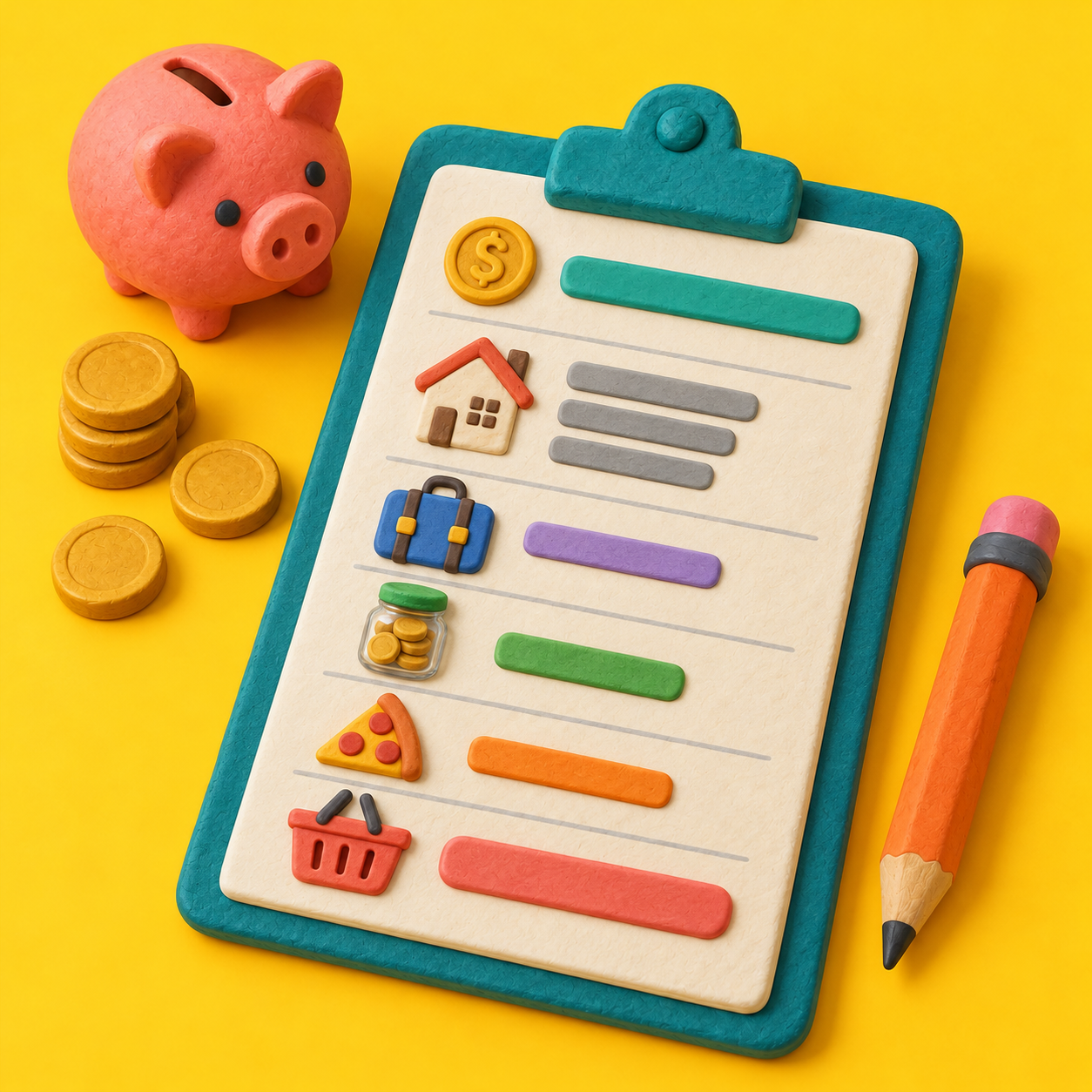
Put your monthly income, essential bills, family priorities and flexible spending on one page. You need about twenty minutes and your last month of bank activity.
Step 1: Write your monthly number at the top
Start with what comes in during a typical month. Use your low month if income varies. One number, top of the page. Everything else on the sheet answers to it.
Step 2: List your must-pay bills
Down the left side, list the bills that keep the household running: housing, utilities, groceries, gas, insurance, phone, minimum debt payments. Write the amount next to each, then add them up and write the total in bold.
Step 3: Choose three priorities
After covering essential bills and leaving a buffer, choose up to three things your family wants to fund with the money remaining. Give each a line and a monthly amount:
- Trip or fun fund
- Savings cushion
- Extra on a debt
- Kids' activities or homeschool supplies
- Date night or pizza Friday
Small amounts count. A priority with $25 a month is a priority that exists, and existing is what matters at the start.
Step 4: Give flexible spending one number
Everything that is not a bill or a priority, like takeout, clothes, subscriptions and little extras, gets one shared amount for the month. Not fifteen categories. One number. When it is spent, flexible spending waits for next month.
Step 5: Check that the page balances
Income minus bills minus priorities minus flexible should land at zero or a small positive buffer. If it lands negative, adjust in this order: shrink flexible first, then shrink priorities, never invent income.
Step 6: Put the page where life happens
Tape it inside a cabinet, pin it by the coffee maker, or snap a photo as your phone wallpaper so you can check it before spending.
Step 7: Hold a weekly five-minute check
Once a week, glance at the page and answer three questions: did the bills get paid, did the priorities get funded, and how much flexible is left. That is the entire meeting. Adjust next week's spending, not the page.
For another way to practice the same weekly check, a no spend month uses the same weekly check at a higher intensity.
A filled-in example
Here is a finished one-page budget for a family with $4,600 coming in:
- Income: $4,600
- Bills: rent $1,650, utilities $280, groceries $700, gas $240, insurance $190, phone $95, minimums $165 - total $3,320
- Priorities: trip fund $150, cushion $200, pizza Friday $60 - total $410
- Flexible: $620
- Buffer: $250 stays in checking
Try it tonight
- Write your low-month income at the top of any sheet of paper.
- List your bills down the left side and total them.
- Subtract, and split what is left between three priorities and one flexible number.
- Tape the page inside a cabinet door and take a photo of it.
Twenty minutes, start to finish. Refine the amounts after the first weekly check.
Common mistakes to avoid
- Too many categories. Fifteen lines of tracking is more than a busy week has room for. One flexible number keeps the weekly check short.
- Budgeting the good month. Build on your low month and let good months be bonuses.
- Skipping priorities. Include a family goal when the amount left after essential bills and a buffer allows it.
- Rewriting weekly. Adjust spending during the week, and adjust the page once a month at most.
Questions families ask
What if the numbers do not fit on one page? Combine until they do. The limit is the point: it forces every line to earn its place, and a page you can take in at a glance is the feature that keeps you looking.
How often should I rewrite the page? Once a month at most, and only when something real changes: a new bill, a paid-off debt, a new priority. Weekly tweaks belong to spending, not the page.
Where does irregular income go? Budget on the low month. When a bigger month arrives, assign the extra the same day: buffer first, then priorities.
What if I want more detail later? Grow the habit first. Once the one-page version has run for a couple of months, you can split flexible spending into two or three lines if a real question needs it. The consumer.gov budget guide has a more detailed worksheet when you are ready.
Share This Guide
Recommended Posts
- Paper, App or Spreadsheet: How to Choose Your Budget TrackerThe right budget tracker is the one you open every week. Compare paper, apps and spreadsheets, then run the two-week trial that picks yours.
- How to Build a Breakfast Rotation Around Your Family's FavoritesA breakfast rotation built from your family's real favorites ends the daily breakfast decision. The grid, the shopping rhythm and the prep habit.
- How to Build a Family Budget Around Your PrioritiesBuild a family budget that covers essential bills and makes room for your priorities. Seven steps, a sample month and a weekly check-in.
Recent Posts
- How to Prep Grab-and-Go Breakfasts for the WeekOne weekend prep session sets up a week of grab-and-go breakfasts. The system, the storage rules and a full sample session.
- High-Protein Breakfasts You Can Prep AheadHigh-protein breakfasts that hold up in the fridge: the prep-ahead players, one weekend session, and kid-friendly balance without counting grams.
- How To Organize A Substitute Teacher BinderHow to organize a substitute teacher binder so a sub can run your class smoothly, with a list of what to include.
- How To Track Homeschool Attendance HoursHow to track homeschool attendance and learning hours simply, so your records are ready when you need them.
- 7-Day Juice Plan For BeginnersA simple 7-day juice plan for beginners, with how to shop, prep and plan juices so your produce does not go to waste.